
Ancient Israel & Biblical Period (Pre-70 CE)
This era encompasses foundational narratives, from Abraham’s origins (c․ 2166-1991 BCE) through the Exodus, formation of tribes, and the establishment of kingdoms before 70 CE, a pivotal historical juncture․
Early origins trace back to patriarchal figures, while the timeline reveals a complex development of Israelite identity and religious practices over centuries․
Significant events, like the conquest of Jerusalem by King David (c․ 1000 BCE), shaped the political and spiritual landscape of ancient Israel․
Early Origins & Patriarchs (c․ 2166-1600 BCE)
The period spanning approximately 2166 to 1600 BCE marks the formative stage of Israelite beginnings, deeply rooted in patriarchal narratives․ Central to this era are the figures of Abraham, traditionally dated around 2166 BCE, considered the progenitor of the Jewish people and a pivotal figure in monotheistic faith․ Genesis 11:27ff details his lineage and the divine covenant established with him, laying the groundwork for a chosen people and a promised land․
Following Abraham, Isaac and Jacob continued this lineage, solidifying the covenant and establishing the twelve tribes, the foundational building blocks of Israelite society․ These patriarchs were nomadic, often interacting with neighboring cultures, yet maintaining a distinct identity centered around the worship of a single God․ Their stories, passed down through oral tradition and later recorded in the Torah, are not merely historical accounts but also theological statements about God’s relationship with humanity and the origins of the Israelite nation․
This period represents the genesis of a unique cultural and religious identity, setting the stage for the subsequent events of the Exodus and the formation of the Israelite tribes․
Abraham, Isaac, and Jacob (c․ 2166-1991 BCE)
These three figures – Abraham (c․ 2166-1991 BCE), Isaac, and Jacob – are foundational to the Israelite narrative, representing a divine covenant and the promise of a great nation․ Abraham’s journey, originating in Ur of the Chaldees, involved a call to leave his homeland and journey to Canaan, the land promised to his descendants․ His willingness to obey God’s command established a unique relationship, marked by the covenant of circumcision and the promise of numerous offspring․
Isaac, Abraham’s son, continued this lineage, inheriting the covenant and the promise of the land․ Jacob, later renamed Israel, wrestled with God and received a blessing, becoming the father of the twelve tribes of Israel, the progenitors of the Israelite nation․ Their lives were marked by trials, faith, and divine intervention, shaping their characters and solidifying their roles in God’s plan․
These patriarchal narratives, found in Genesis, are not simply historical accounts but theological statements about God’s faithfulness and the origins of the chosen people․
The Exodus & Formation of the Tribes (c․ 1600-1200 BCE)
This period centers on the Israelites’ liberation from slavery in Egypt, a defining event known as the Exodus (c․ 1600-1200 BCE)․ Led by Moses, they experienced miraculous deliverance, including the parting of the Red Sea, and received the Ten Commandments at Mount Sinai, establishing a covenant with God and a legal and moral framework for their society․ The Exodus narrative emphasizes God’s power, faithfulness, and commitment to his people․
Following the Exodus, the Israelites wandered in the wilderness for forty years before entering the Promised Land, Canaan․ Upon entering, the land was divided among the twelve tribes, each descended from one of Jacob’s sons, forming the basis of Israelite societal structure․ This tribal organization influenced political, social, and religious life for centuries․
The formation of the tribes marked a crucial step in establishing a distinct Israelite identity and laying the groundwork for future nationhood․
The Period of the Judges (c․ 1200-1020 BCE)
Following the settlement of the twelve tribes in Canaan (c․ 1200-1020 BCE), Israel entered a period characterized by decentralized leadership known as the Period of the Judges․ In the absence of a centralized monarchy, charismatic individuals – the Judges – arose to deliver the Israelites from oppression by neighboring peoples․ These leaders, appointed by God, combined military prowess with judicial and spiritual authority․
The Book of Judges recounts cycles of apostasy, oppression, repentance, and deliverance, highlighting the Israelites’ struggles to maintain faithfulness to their covenant with God․ Notable Judges include Deborah, Gideon, and Samson, each facing unique challenges and demonstrating God’s intervention in Israel’s affairs․ This era was marked by frequent conflict and instability․
Ultimately, the period of the Judges demonstrated the need for a unified and stable leadership, paving the way for the establishment of the monarchy․
United Kingdom of Israel (c․ 1020-930 BCE)
The United Kingdom of Israel, spanning roughly from 1020 to 930 BCE, represents a golden age in Israelite history․ This period began with the anointing of Saul as the first king, followed by the reigns of David and Solomon, who consolidated power and established a centralized monarchy․ King David, after conquering Jerusalem, made it the political and religious capital, bringing the Ark of the Covenant to the city․
His son, Solomon, renowned for his wisdom and wealth, constructed the First Temple, a magnificent structure that became the focal point of Israelite worship․ However, Solomon’s later years were marked by heavy taxation and forced labor, sowing seeds of discontent․ This era witnessed significant territorial expansion, economic prosperity, and cultural flourishing․
Ultimately, internal tensions following Solomon’s death led to the kingdom’s division․
King Saul (c․ 1020-1000 BCE)
Saul’s reign, approximately from 1020 to 1000 BCE, marks the transition of the Israelites from a tribal confederacy to a monarchy․ Chosen by the prophet Samuel, Saul was initially a reluctant leader, but he united the tribes to combat external threats, particularly the Philistines․ His early successes included victories against the Ammonites and other neighboring peoples, establishing a degree of security for Israel․
However, Saul’s kingship was marred by disobedience to God’s commands, as interpreted by Samuel, and increasing instability․ He often acted independently, making decisions without consulting divine guidance, leading to a strained relationship with Samuel and ultimately, divine disapproval․ This resulted in the loss of favor and a growing rift between Saul and his future successor, David․
Saul’s reign ended tragically in battle against the Philistines․
King David (c․ 1000-970 BCE)
David’s reign (c․ 1000-970 BCE) represents a golden age in Israelite history, succeeding Saul after a period of conflict and establishing Jerusalem as the nation’s political and religious center․ Initially gaining prominence as a military leader and musician, David’s popularity grew, eventually leading to his anointing as king․ He consolidated power through strategic alliances and military campaigns, defeating the Philistines and expanding Israel’s territory․
A pivotal moment was David’s capture of Jerusalem, transforming it into a fortified capital and bringing the Ark of the Covenant into the city, solidifying its sacred status․ Despite his successes, David’s reign was also marked by personal failings, including his adultery with Bathsheba and the subsequent consequences․
Nevertheless, David laid the foundation for a strong and unified kingdom, preparing the way for his son, Solomon․
King Solomon (c․ 970-930 BCE)
Solomon, succeeding his father David (c․ 970-930 BCE), is renowned for his wisdom, wealth, and ambitious building projects․ His reign marked a period of unprecedented peace and prosperity for Israel, fostering extensive trade networks and diplomatic relations with neighboring kingdoms․ The most significant achievement of Solomon’s rule was the construction of the First Temple in Jerusalem, a magnificent structure dedicated to the worship of God, becoming the central sanctuary for the Israelites․
However, Solomon’s reign also saw increased taxation and forced labor to fund his grand endeavors, sowing seeds of discontent among the populace․ Furthermore, his numerous foreign wives introduced the worship of other gods, leading to religious compromises that would later be condemned by prophets․
Ultimately, Solomon’s policies contributed to the eventual division of the kingdom after his death․
Divided Kingdom: Israel & Judah (c․ 930-722/586 BCE)
Following Solomon’s death around 930 BCE, the united kingdom fractured into two distinct entities: the Northern Kingdom of Israel and the Southern Kingdom of Judah․ This division stemmed from political grievances and religious tensions, fueled by the heavy taxation and idolatry introduced during Solomon’s later years․ Israel, comprising ten tribes, maintained its capital in Samaria, while Judah, consisting of the tribes of Judah and Benjamin, centered around Jerusalem and its Temple․
Throughout their separate existences, both kingdoms faced internal strife and external threats from regional powers like Aram and Assyria․ The Northern Kingdom of Israel ultimately fell to the Assyrian Empire in 722 BCE, resulting in the exile of its population and the loss of its identity․
Judah persisted for over a century longer, until its conquest by the Babylonian Empire in 586 BCE․
Northern Kingdom of Israel (c․ 930-722 BCE)
Comprising ten of the twelve tribes of Israel, the Northern Kingdom established Samaria as its capital after seceding from the unified monarchy around 930 BCE․ Its history was marked by political instability, frequent dynastic changes, and a propensity for syncretistic religious practices, blending the worship of Yahweh with Canaanite deities․ This religious divergence often drew condemnation from prophets in Judah․
Throughout its existence, Israel navigated complex relationships with neighboring kingdoms, including Aram-Damascus and Phoenicia, often engaging in both alliances and conflicts․ The kingdom’s economic strength rested on its fertile lands and strategic location along trade routes․
Ultimately, the Northern Kingdom succumbed to the expanding Assyrian Empire in 722 BCE, following a prolonged siege of Samaria․ The Assyrians deported a significant portion of the population, leading to the “lost tribes of Israel” and a lasting demographic shift․
Southern Kingdom of Judah (c․ 930-586 BCE)
Consisting of the tribes of Judah and Benjamin, the Southern Kingdom centered around Jerusalem and maintained the Davidic dynasty, emphasizing adherence to the worship of Yahweh at the Temple․ Its history, following the division of the united monarchy around 930 BCE, was characterized by a complex interplay of religious reform, political intrigue, and external threats․

Judah frequently clashed with neighboring kingdoms, including Israel, Egypt, and Assyria, often seeking alliances to ensure its survival․ The prophetic tradition flourished within Judah, with figures like Isaiah and Jeremiah warning against idolatry and advocating for social justice․
Despite periods of prosperity under kings like Hezekiah and Josiah, Judah ultimately fell to the Babylonian Empire in 586 BCE, resulting in the destruction of the First Temple and the exile of its elite to Babylon․
Assyrian & Babylonian Conquests (722-539 BCE)
Beginning with the Assyrian conquest of the Northern Kingdom of Israel in 722 BCE, this period marked a dramatic shift in the geopolitical landscape of the region․ The Assyrians deported large segments of the Israelite population, replacing them with people from other conquered territories, leading to a loss of tribal identity․
Subsequently, the Neo-Babylonian Empire, under Nebuchadnezzar II, rose to prominence, conquering Judah in 586 BCE․ This resulted in the destruction of Jerusalem and the First Temple, a pivotal event in Jewish history, and the subsequent Babylonian exile․
The exile profoundly impacted Jewish religious and cultural identity, fostering a period of reflection and the development of new theological concepts․ These conquests fundamentally altered the political and demographic makeup of the land․
The Babylonian Exile (586-539 BCE)
Following the destruction of Jerusalem in 586 BCE, the elite of Judah were exiled to Babylon, initiating a period known as the Babylonian Exile․ This wasn’t merely a political displacement; it was a profound cultural and religious trauma for the Jewish people, fundamentally reshaping their identity․
During exile, Jewish communities maintained their traditions, developing synagogues as centers for worship and study, replacing the Temple’s role․ The compilation and editing of the Hebrew Bible likely progressed during this time, solidifying religious texts․
This period fostered a sense of collective memory and a longing for Zion, influencing future Jewish thought and practice․ The exile ended with the Persian conquest of Babylon in 539 BCE, paving the way for a return to Judah․
Second Temple Period (539 BCE ౼ 70 CE)
Commencing with Cyrus the Great’s decree in 539 BCE, the Second Temple Period witnessed the return of Jewish exiles to Judah and the rebuilding of the Temple in Jerusalem․ This era, spanning six centuries, was marked by significant political and religious developments under Persian, Hellenistic, and Roman rule․
Hellenistic influence brought both cultural exchange and conflict, culminating in the Maccabean Revolt (167-160 BCE) and the establishment of an independent Hasmonean kingdom․ The subsequent Roman conquest in 63 BCE brought a new layer of political complexity․
Internal divisions and growing tensions with Roman authorities ultimately led to the First Jewish-Roman War (66-70 CE), culminating in the Temple’s destruction in 70 CE, marking the end of this pivotal period․
Return from Exile & Rebuilding the Temple (539-515 BCE)
Following the Babylonian Exile, the pivotal decree of Cyrus the Great in 539 BCE authorized the Jewish people to return to Judah and rebuild their Temple․ This marked a transformative moment, initiating a period of restoration and renewed religious life․
Led by figures like Zerubbabel and Ezra, the returning exiles faced challenges including opposition from surrounding populations and economic hardship․ Despite these obstacles, construction of the Second Temple commenced, symbolizing a restoration of Jewish identity․
Completed in 515 BCE, the rebuilt Temple became the central focus of Jewish worship and a symbol of hope․ This period laid the foundation for the subsequent Second Temple Period, shaping Jewish religious and cultural practices for centuries to come․

Roman & Byzantine Rule (70 CE ౼ 636 CE)
This period witnessed Roman control, Jewish revolts, and ultimately, Byzantine governance, shaping the land’s political and religious landscape for centuries․
Roman Rule & Jewish Revolts (70-135 CE)
Following the destruction of the Second Temple in 70 CE, Roman authority solidified, initiating a period marked by escalating tensions and ultimately, widespread Jewish uprisings․ The First Jewish-Roman War (66-73 CE) culminated in the siege of Jerusalem and the temple’s devastation, profoundly altering Jewish religious life and scattering the population․
Despite the initial suppression, unrest continued to simmer, erupting again in the Kitos War (115-117 CE) across various regions, including Egypt, Cyrenaica, and Judea․ However, the most significant challenge to Roman dominion came with the Bar Kokhba revolt (132-135 CE), a large-scale rebellion led by Simon Bar Kokhba, aiming to restore Jewish independence․
This revolt, though initially successful, was brutally crushed by the Romans under Emperor Hadrian, resulting in immense casualties and further displacement of the Jewish population․ Hadrian subsequently implemented policies aimed at erasing Jewish identity, renaming Jerusalem as Aelia Capitolina and restricting Jewish religious practices, fundamentally reshaping the region’s demographic and cultural composition․
The Bar Kokhba Revolt (132-135 CE)
Triggered by Roman restrictions on Temple Mount access and Hadrian’s plans to build a temple to Jupiter, the Bar Kokhba revolt (132-135 CE) represented a desperate, yet determined, attempt to regain Jewish independence․ Led by Simon Bar Kokhba, hailed by some as a messianic figure, the rebellion initially achieved remarkable success, establishing a short-lived Jewish state in Judea․
Bar Kokhba’s forces captured key cities and fortresses, issuing their own coinage and laws, demonstrating a functional administrative structure․ However, the Romans, under the command of Sextus Julius Severus, responded with overwhelming force, employing advanced siege tactics and relentless campaigns to suppress the uprising․
The revolt ultimately ended in a devastating defeat for the Jewish rebels, marked by immense casualties and widespread destruction․ The suppression was brutal, with Hadrian enacting harsh measures to punish the Jewish population and further consolidate Roman control, leaving a lasting impact on the region’s history and demographics․
Byzantine Rule (395-636 CE)
Following the division of the Roman Empire in 395 CE, Judea, then known as Palestine Prima, fell under Byzantine control․ This period witnessed a complex interplay of religious and political developments, marked by fluctuating levels of tolerance towards the Jewish population․ While initially maintaining some degree of autonomy, Jewish communities faced increasing restrictions and discriminatory policies․
The Byzantine authorities implemented laws limiting Jewish rights, including restrictions on building new synagogues and holding public office․ Religious tensions frequently erupted, fueled by theological disputes and imperial decrees․ Samaritans also experienced persecution during this era, adding to the region’s instability․
Despite these challenges, Jewish life persisted, with centers of learning and religious practice continuing to function․ However, the Byzantine period ultimately concluded with the rise of Islam and the subsequent Arab conquest in 636 CE, ushering in a new chapter in the history of the land․

Medieval Period (636-1917)

This expansive era features Islamic rule, Crusader kingdoms, Mamluk governance, and centuries under the Ottoman Empire, shaping the land’s cultural and political landscape․
Early Islamic Rule (636-1099)
Following the Byzantine period, the 7th century witnessed a transformative shift with the arrival of Islamic rule in 636 CE․ This marked a significant turning point in the region’s history, initiating a new era characterized by Arab administration and the gradual Islamization of the population․ Early Islamic rule wasn’t immediately disruptive; initially, many Christians and Jews continued practicing their faiths, albeit under new governance and with certain restrictions․
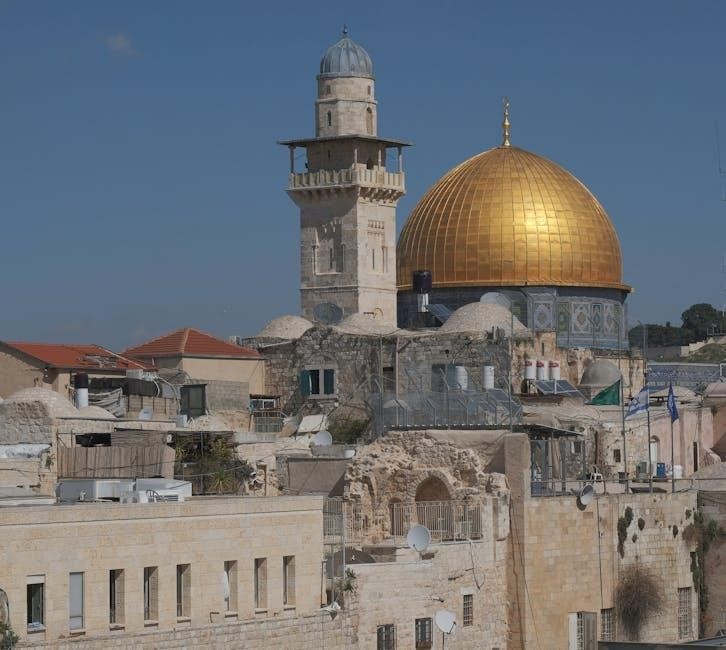
Jerusalem, a city of immense religious importance, fell under Islamic control, and the Dome of the Rock was constructed on the Temple Mount, becoming a prominent Islamic shrine․ The region, then known as Palestine, became a province within the expanding Islamic caliphates, experiencing periods of relative peace and prosperity alongside administrative changes․ This period laid the groundwork for the cultural and demographic shifts that would define the subsequent centuries, influencing the region’s identity and setting the stage for the Crusader period․
Crusader Period (1099-1291)
The Crusader period, commencing in 1099 with the First Crusade’s capture of Jerusalem, dramatically reshaped the Holy Land․ European Christian forces established a series of Crusader states, including the Kingdom of Jerusalem, fundamentally altering the region’s political and religious landscape․ This era was marked by intense conflict between Crusaders, Muslim forces, and local populations, resulting in widespread violence and instability․
Jerusalem became the capital of the Crusader Kingdom, attracting pilgrims and settlers from Europe․ However, Crusader rule was constantly challenged by surrounding Muslim powers, leading to a series of battles and shifting control over key cities and territories․ Despite establishing castles and infrastructure, the Crusader presence remained precarious, ultimately culminating in their defeat by the Mamluks in 1291, marking the end of their dominion in the region and ushering in a new phase of Mamluk control․
Mamluk Rule (1291-1516)
Following the expulsion of the Crusaders in 1291, the Mamluk Sultanate of Egypt assumed control of the region, including the territory encompassing modern Israel․ Mamluk rule, lasting until 1516, was characterized by a focus on consolidating power and rebuilding infrastructure damaged during the Crusades․ They implemented administrative and economic policies aimed at stabilizing the region, though often with a heavy hand․
Jerusalem remained an important religious center, but faced periods of neglect and fluctuating levels of access for pilgrims․ The Mamluks engaged in frequent conflicts with various powers, including the Mongols and local Bedouin tribes, maintaining a military presence to secure their control․ This period witnessed a decline in Christian influence and a resurgence of Islamic institutions, shaping the cultural and demographic landscape of the land before the arrival of the Ottoman Empire․
Ottoman Rule (1516-1917)
The Ottoman Empire’s conquest in 1516 marked a significant shift, incorporating the region of Palestine, including present-day Israel, into its vast dominion for four centuries․ Initially, Ottoman rule brought a degree of stability and administrative organization, dividing the area into districts governed by appointed officials․ Jerusalem experienced periods of renovation and religious tolerance, though subject to Ottoman law and taxation․
Over time, the central authority weakened, leading to increased local autonomy and the rise of powerful families․ The 19th century witnessed growing European influence, particularly from France and Britain, alongside increased Jewish immigration․ Towards the end of Ottoman rule, nationalist sentiments began to emerge, setting the stage for the British Mandate and the eventual creation of modern Israel, fundamentally altering the region’s trajectory․

Modern Israel (1917-Present)
This period details the British Mandate, Israel’s 1948 establishment, subsequent conflicts, and recent events, reflecting resilience, justice, and enduring hope for the nation․
British Mandate (1920-1948)
Following World War I, the League of Nations granted Britain a mandate over Palestine in 1920, reshaping the region’s political landscape․ This period witnessed increasing Jewish immigration, fueled by Zionist aspirations for a national homeland, and growing Arab nationalism, leading to escalating tensions and conflicts․
The British administration faced the challenging task of balancing competing claims to the land, attempting to implement policies that addressed both Jewish and Arab concerns․ However, restrictions on immigration and land purchases, coupled with outbreaks of violence, created a volatile environment․
Key events included the 1929 Arab riots and the Peel Commission’s 1937 proposal for partition, which was rejected by Arab leaders․ As the situation deteriorated, Britain proposed various plans for dividing Palestine, but none gained widespread acceptance․ Ultimately, the British Mandate ended in 1948, paving the way for the establishment of Israel and the first Arab-Israeli War․
1948 Arab-Israeli War & Establishment of Israel (1948)
On May 14, 1948, David Ben-Gurion proclaimed the establishment of the State of Israel, immediately triggering the first Arab-Israeli War․ Neighboring Arab states – Egypt, Jordan, Syria, Lebanon, and Iraq – invaded, aiming to prevent Israel’s creation and asserting control over Palestinian territory․

The war was marked by intense fighting, with Israel defending its newly declared independence against a numerically superior Arab force․ Despite facing significant challenges, Israel secured crucial victories, expanding its territory beyond the UN Partition Plan’s boundaries․
The conflict resulted in a Palestinian exodus, known as the ‘Nakba’ (catastrophe), with hundreds of thousands of Palestinians becoming refugees․ Armistice agreements were signed in 1949, solidifying Israel’s existence and establishing new borders, although the underlying issues remained unresolved, setting the stage for future conflicts․

Subsequent Conflicts (1948-Present)
Following the 1948 Arab-Israeli War, the region experienced a series of conflicts, deeply shaping Israel’s history․ The Suez Crisis of 1956 involved Israel, Britain, and France against Egypt, highlighting Cold War dynamics․ The Six-Day War in 1967 resulted in Israel’s capture of the West Bank, Gaza Strip, Sinai Peninsula, and Golan Heights, dramatically altering the geopolitical landscape․
The Yom Kippur War in 1973, launched by Egypt and Syria, aimed to regain lost territory, but ended in a stalemate․ The First Intifada (1987-1993) was a Palestinian uprising against Israeli occupation, leading to the Oslo Accords, a series of agreements aimed at peace․
However, the Second Intifada (2000-2005) erupted, marked by increased violence․ Subsequent conflicts in Gaza (2008-2009, 2012, 2014, 2021, 2023) and Lebanon (2006) continue to define the ongoing Israeli-Palestinian conflict and regional instability․

Six-Day War (1967)
The Six-Day War, fought in June 1967, remains a pivotal event in Israeli history․ Triggered by Egypt’s mobilization of troops and blockade of the Straits of Tiran, Israel launched a preemptive strike against Egyptian airfields, achieving decisive air superiority․ This swiftly led to conflict with Jordan and Syria as well․
Within six days, Israel captured the Sinai Peninsula and Gaza Strip from Egypt, the West Bank from Jordan, and the Golan Heights from Syria․ The war dramatically expanded Israel’s territorial control, resulting in the occupation of Palestinian territories․
The conflict’s outcome reshaped the geopolitical map of the Middle East, creating a prolonged Israeli-Palestinian conflict and setting the stage for future regional tensions․ Resolution 242 of the United Nations called for Israel’s withdrawal from territories occupied in the war, a demand that remains central to peace negotiations․
Yom Kippur War (1973)
The Yom Kippur War, initiated on October 6, 1973, during the holiest day in Judaism, caught Israel largely by surprise․ A coordinated attack by Egypt and Syria aimed to regain territories lost during the Six-Day War of 1967; Egyptian forces crossed the Suez Canal, while Syrian troops advanced into the Golan Heights․
Initial setbacks for Israel were followed by a determined counteroffensive, aided by substantial military aid from the United States․ After intense fighting, a ceasefire was brokered by the United Nations․ Though Israel ultimately repelled the attack, it suffered significant casualties and experienced a shock to its national confidence;
The war led to the 1978 Camp David Accords between Israel and Egypt, brokered by US President Jimmy Carter, resulting in a peace treaty and Israel’s withdrawal from the Sinai Peninsula․ It also highlighted the complexities of the Arab-Israeli conflict and the importance of diplomatic solutions․
Recent Events (2023-Present)
October 7, 2023, marked a dramatic turning point with a large-scale surprise attack on Israel by Hamas militants from Gaza․ This involved rocket barrages and infiltrations into Israeli territory, resulting in significant casualties and the taking of hostages․ Israel responded with extensive airstrikes and a ground offensive into Gaza, aiming to dismantle Hamas’s infrastructure․
The conflict triggered a humanitarian crisis in Gaza, with widespread displacement and shortages of essential supplies․ International efforts focused on securing the release of hostages and achieving a ceasefire, but negotiations proved challenging․ Regional tensions escalated, with concerns about wider involvement from other actors․
This period represents a continuation of the long-standing Israeli-Palestinian conflict, characterized by cycles of violence and stalled peace efforts․ The events of 2023-present underscore the urgent need for a sustainable resolution to address the underlying causes of the conflict․